How does the Bizkaia Bridge gondola work?
A FERRY HUNG FROM A GIRDER · CROSSING, AND CLIMBING TO THE TOP
The Bizkaia Bridge does not carry traffic over the river: a gondola hanging from a high girder ferries cars and people across the mouth of the Ría. How the transporter bridge works, why it was built that way, what happened to it in the Civil War, and how to ride it and walk across the top.
Read on
The answer in full
The short answer
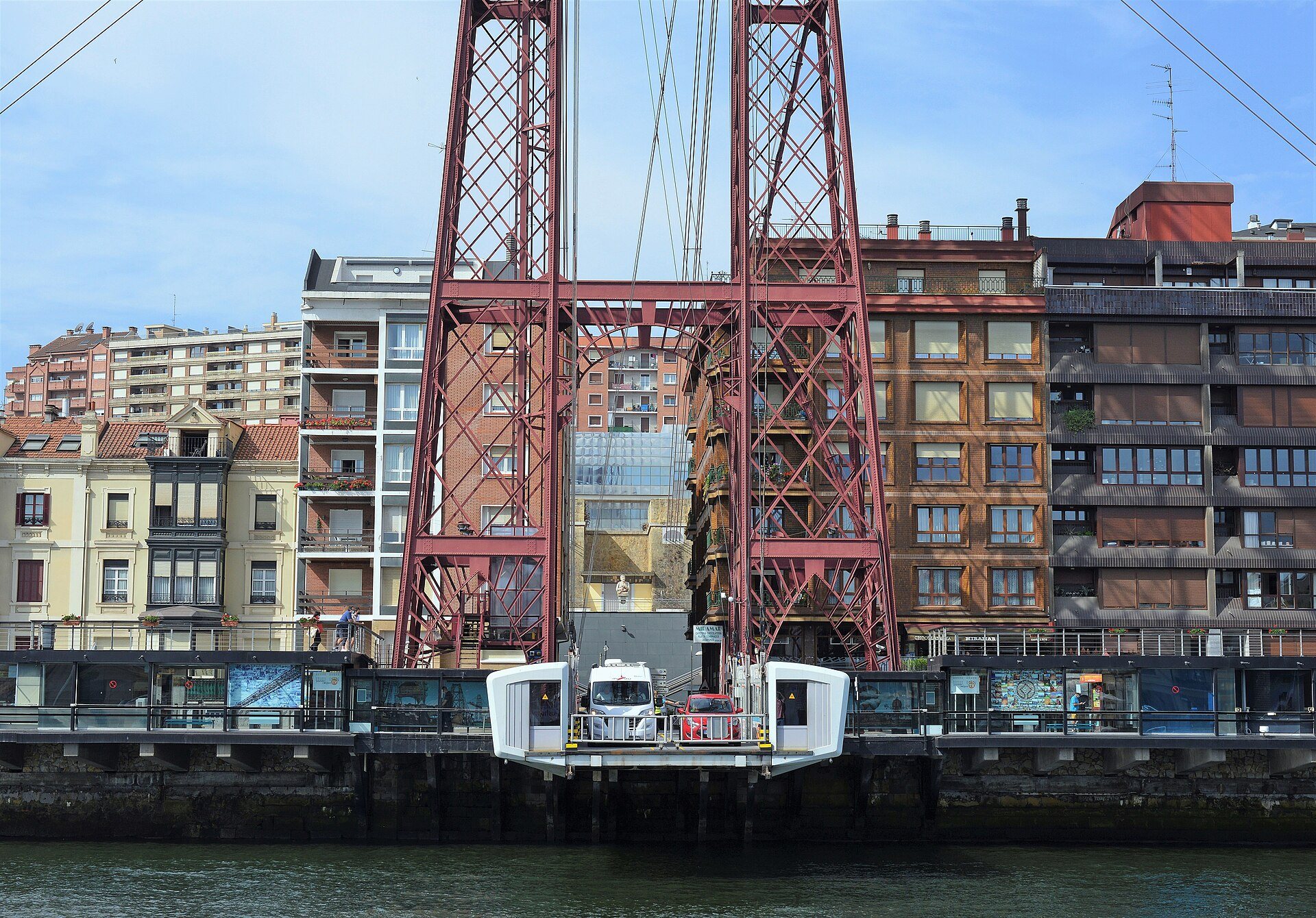
The Bizkaia Bridge, which links Portugalete on the left bank of the Ría with Las Arenas in Getxo on the right, is a transporter bridge. Instead of a deck that people and cars cross, it has a high horizontal girder carried by towers on each bank, and from that girder hangs a gondola, a kind of suspended ferry, which a trolley running along rails in the girder pulls from one side to the other, just above the water.
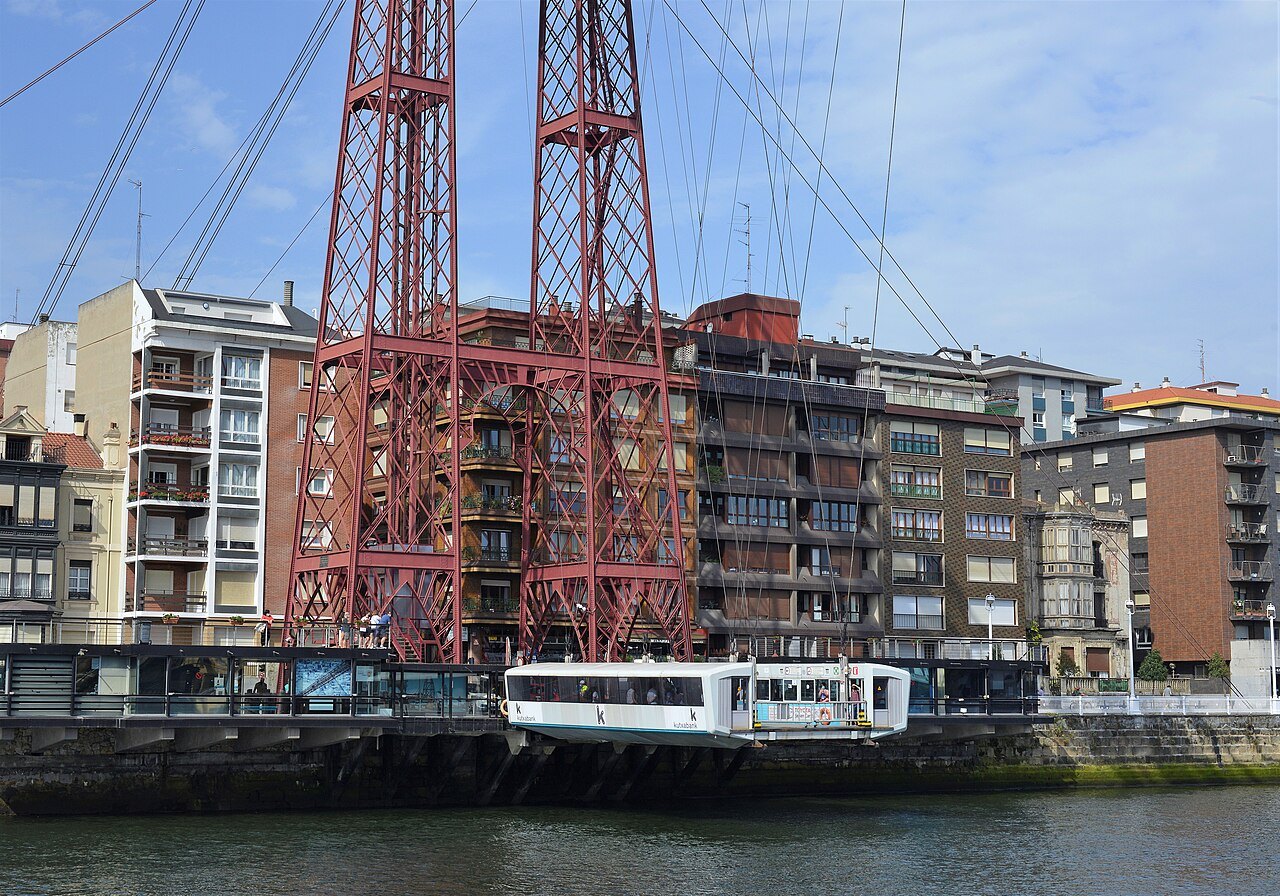
The gondola carries six cars and several dozen passengers at a time, and the crossing takes about a minute and a half. It runs all day and all night, every day of the year, and the Barik transport card is accepted. Separately, lifts in the towers take visitors up to a walkway along the top girder, about 50 meters above the river.
Why a bridge that hangs
At the end of the nineteenth century the mouth of the Ría was one of the busiest stretches of water in Spain, the entrance to the port of Bilbao, and tall-masted ships had to pass freely. The two banks, with their seaside resorts for the industrial middle class and for visitors, needed joining, but a fixed bridge low enough to be practical would have blocked the shipping, and one high enough would have needed huge ramps on both sides.
The answer, designed by the architect Alberto de Palacio, a disciple of Gustave Eiffel, was to put the structure high above the masts and bring only a small gondola down to the level of the banks. The French engineer and cable maker Ferdinand Arnodin worked on the design and the construction, and the bridge, built privately between 1890 and 1893, opened on 28 July 1893. It was the first bridge of its kind in the world, and it became the model for transporter bridges in Europe, Africa and the Americas.
One bridge, many names
The bridge has almost as many names as uses. Its official name is Puente Bizkaia, Bizkaiko Zubia in Basque, but most people around the Ría call it the Puente Colgante, the hanging bridge, the Spanish term for a suspension bridge, even though its structure is quite different. It is also called the Puente de Portugalete, because it once joined Portugalete with Las Arenas de Portugalete, when both banks were thought of as one place, and the Puente Palacio, after its designer.
How it is built
Four iron towers, 61 meters high, stand in pairs on the two banks. Between them runs the upper girder, about 160 meters long, held by suspension cables and braced by further cables anchored into the hill behind Portugalete and the ground at Las Arenas. Along the girder run the rails for the trolley, a carriage on 36 wheels, from which the gondola hangs on cables.
UNESCO, which declared the bridge a World Heritage Site on 13 July 2006, chosen from 37 candidates, singled out its combination of iron architecture with light twisted steel cables, a new way of building bridges that was copied around the world. In Spain it is the only monument in the industrial heritage category.
Destroyed and rebuilt
The bridge's service has been interrupted only once. In June 1937, during the Civil War, Republican engineers were ordered to destroy every crossing of the Ría to slow the advance of Franco's troops, and on 17 June the upper girder was blown up and fell into the water. Palacio, who lived in Portugalete, saw his bridge wrecked shortly before his own death.
It was rebuilt to a design by the civil engineer José Juan Aracil, who updated the original girder and cables, and went back into service on 19 June 1941. The assembly started at the center of the span and worked out towards both banks. Since the bridge opened, five gondolas have hung from it in turn, each safer than the last.
The color
For most of its life the bridge was painted black, or at times smoke gray. Dark paint absorbs heat and makes the metal expand more sharply, which damaged some parts, so a restoration approved in 2010 included a change of color. Three shades were proposed, each based on an iron ore from the mines of the nearby Triano hills, and the reddish tone of the hematite of Somorrostro was chosen. The bridge's color is, in that sense, the color of the iron that made the region rich.
Riding the gondola
The gondola is a working ferry first, used by local people because it saves a road journey of almost 20 kilometers between Getxo and Portugalete. Some four million passengers and half a million vehicles use it each year. Pay at the access building on either bank, by card or with the Barik card, and walk on with the cars; the gondola leaves at short intervals through the day and less often at night.
The ride is short and smooth. Stand near the side for the view up the Ría towards Bilbao and out to the bay of the Abra, and look up at the trolley and cables as you glide under the girder.
Walking across the top
Works carried out in 1999 added lifts in the towers on both banks and a walkway along the upper girder, so that visitors can cross at the top. The visit to the walkway is sold separately from the gondola. From up there you look down on the gondola crossing, along the river to the city, and out over the port and the bay. On a windy or wet day it can be exposed; choose a clear one if you can.
Prices and visiting times are set by the company that runs the bridge and change, so check its official site before you go.
Getting there
From central Bilbao take Metro line 1 to Areeta, a short walk from the Las Arenas end, or line 2 or the C-1 commuter train to Portugalete on the other side. A good plan is to arrive on one line, cross by gondola, and return on the other, and to combine the bridge with Getxo's seafront and the old port of Algorta. The itineraries page builds it into a day.
More from the journal
Read next
- Getting HereHow do you get from Bilbao Airport to the city?Bilbao Airport is at Loiu, over the hills north of the city. The airport bus to the Plaza Elíptica and the Intermodal bus station, taxis, and the direct coaches to San Sebastián and Vitoria-Gasteiz, and how to choose between them by where you are staying.Read the piece →
- The GuggenheimHow was the Guggenheim Bilbao built?Frank Gehry's museum looks as if its curves were thrown together at random, but it was built on time and on budget with the help of aerospace software. How it stands on the soft bed of the estuary, why it is clad in titanium scales, how its galleries are arranged, and what to look for when you visit.Read the piece →
- Eating & DrinkingHow do pintxo bars in Bilbao work?In Bilbao people eat out standing at a bar counter, one or two pintxos and a small drink at a time, then on to the next bar. What a pintxo is, how it differs from a tapa, how to order and pay, what to drink with it, and the local specialities to look for.Read the piece →